When Low Body Fat Becomes Unhealthy: The Risks of Getting Too Lean
In fitness culture, getting lean is often treated as the ultimate sign of discipline.
Visible abs. Muscle definition. Vascularity. A lower number on the body-fat scan.
Social media can make it seem as though the leaner you become, the healthier and fitter you must be.
But leaner doesn't automatically mean healthier.
There is a major difference between reducing excess body fat while building a strong, healthy body and becoming obsessed with maintaining the lowest body-fat percentage possible. When getting lean requires chronic calorie restriction, excessive exercise, anxiety around food, or sacrificing recovery and hormonal health, the pursuit of fitness can begin working against you.
At evol, fitness should be about creating a body that performs well, recovers well, and supports your life—not simply chasing the lowest number you can achieve.
Body Fat Isn't the Enemy
Body fat frequently gets portrayed as something we need to eliminate, but your body actually requires fat.
Adipose tissue is involved in energy storage, insulation, hormone signaling, and other physiological functions. The goal of a healthy fitness program isn't to eliminate body fat. It's to maintain a body composition that supports your health, performance, and personal goals.
There's also no single "perfect" body-fat percentage that applies to everyone.
Sex, age, genetics, sport, muscle mass, hormones, training volume, and individual physiology all influence what is sustainable for a particular person.
That's why comparing your body-fat percentage with an influencer, bodybuilder, athlete, or even your workout partner can be misleading.
How Lean Is Too Lean? Healthy Body Fat Percentages for Men and Women
There isn't one exact body-fat percentage where someone suddenly goes from healthy to unhealthy. Age, sex, genetics, muscle mass, hormones, nutrition, training intensity, and overall energy availability all play a role. However, general ranges can help put extremely low body-fat goals into perspective.
For fitness-focused adults, a visibly lean and athletic physique can often be achieved without pushing body fat to extreme levels.
| Body Fat Level | Men | Women |
|---|---|---|
| Typical Non-Athlete Range | ~18–24% | ~25–31% |
| Lean / Fit | ~14–17% | ~21–24% |
| Very Lean / Athletic | ~6–13% | ~14–20% |
| Too Lean / Potentially Unsustainable | Below ~6% | Below ~14% |
When “Very Lean” Starts Becoming Too Lean
The important distinction is that the very lean/athletic range isn't automatically unhealthy. Some athletes can reach these levels while maintaining adequate nutrition, recovery, hormonal function, and performance.
However, as body fat approaches the bottom of these ranges—particularly single-digit body fat in men and the mid-to-low teens in women—maintaining that physique can become increasingly difficult and may require behaviors that aren't sustainable year-round.
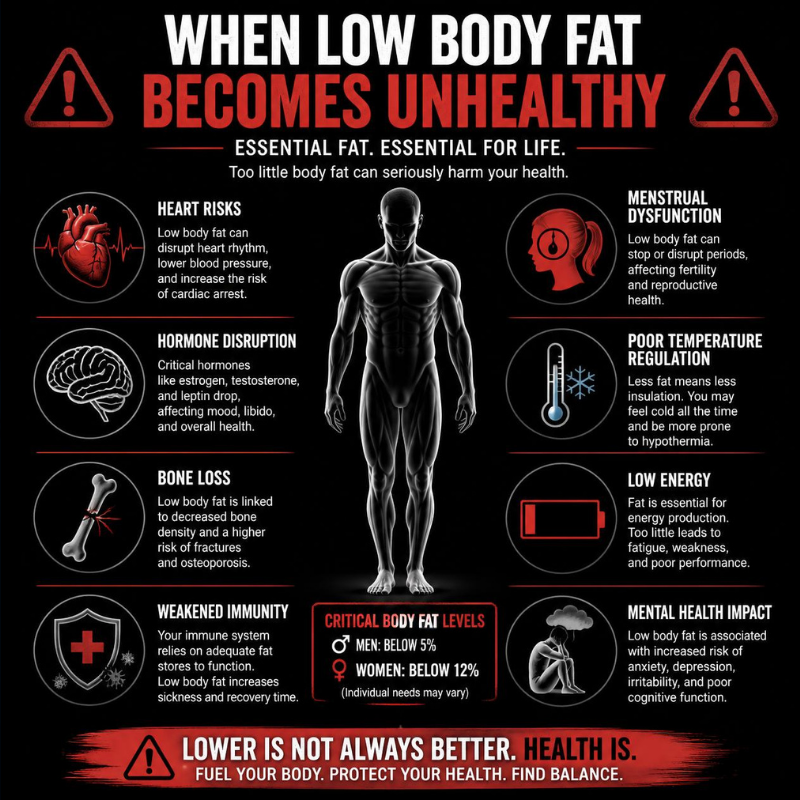
Body fat below roughly 6% in men or 14% in women should be treated as an extreme level of leanness rather than a general fitness goal. These numbers aren't hard medical cutoffs, and individual responses vary considerably.
More importantly, someone doesn't have to cross those percentages before experiencing problems. If getting or staying lean results in persistent fatigue, declining strength, poor recovery, hormonal or menstrual changes, reduced libido, frequent injuries, constant hunger, sleep problems, food obsession, or anxiety about gaining body fat, the current level of leanness may already be too aggressive for that individual.
The goal shouldn't be to find the lowest body-fat percentage your body can tolerate. It should be to find the leanest physique you can maintain while still feeling, performing, recovering, and living well.
The Problem With Chasing Extremely Low Body Fat
Getting extremely lean usually requires an energy deficit.
For a temporary fat-loss phase, a reasonable calorie deficit may be perfectly appropriate. But continually attempting to become leaner can eventually create a situation where the body isn't receiving enough energy to support both exercise and normal physiological functions.
This is known as low energy availability (LEA).
The International Olympic Committee describes Relative Energy Deficiency in Sport, or REDs, as a syndrome involving negative health and performance outcomes associated with problematic low energy availability in both male and female athletes.
And here's an important distinction:
You don't necessarily have to look dangerously thin to be under-fueled.
The American College of Sports Medicine notes that athletes can experience low energy availability even while remaining weight stable. Potential signs can include constantly feeling cold, menstrual disturbances, reduced libido, persistent thoughts about food, poor concentration, and sleep problems.
In other words, your physique doesn't always tell the full story.
What Can Happen When You Get Too Lean?
Maintaining an extremely lean physique can come with consequences, particularly when that leanness is achieved through chronic under-fueling.
1. Hormones Can Be Disrupted
Your body has priorities.
When available energy becomes scarce, it may reduce energy expenditure toward physiological processes that aren't immediately necessary for survival.
Hormonal and reproductive function can consequently suffer.
NEDA lists loss of menstrual cycles in women and low testosterone in men among potential health consequences associated with excessive exercise, alongside RED-S.
Losing your period because you're extremely lean or training excessively should not simply be viewed as evidence that you're "hardcore."
It's a health signal worth discussing with a qualified healthcare professional.
2. Your Workouts Can Actually Get Worse
This is one of the great contradictions of extreme leanness.
You might be getting leaner because you want to look more athletic, yet eventually the behaviors required to maintain that physique can make athletic performance worse.
Inadequate fueling and excessive training can contribute to:
- Persistent fatigue
- Reduced training response
- Poor recovery
- Muscle soreness
- Sleep problems
- More frequent illness
- Increased injury risk
NEDA identifies these among the potential consequences associated with excessive exercise.
If you're constantly exhausted, your lifts are falling, you're sleeping poorly, and every workout feels harder than it should, getting even leaner probably isn't the solution.
3. Bone Health Can Suffer
Muscle gets most of the attention in fitness, but your bones are adapting to training too.
Chronic under-fueling can negatively affect bone health, and excessive exercise combined with inadequate energy availability may increase the risk of problems including bone-density loss and stress injuries.
This is another reason nutrition should be considered part of your training program rather than something working against it.
Food isn't interfering with your progress. Food helps make progress possible.
4. You May Sacrifice Muscle to Stay "Shredded"
There's another problem with endlessly dieting:
Eventually you're no longer just trying to lose unwanted fat.
You're trying to convince an increasingly lean body to continue losing weight while simultaneously asking it to train hard and maintain muscle.
Those goals can become increasingly difficult to reconcile.
If maintaining your physique requires constantly reducing calories while increasing cardio, you should ask an important question:
Am I actually improving my fitness—or just getting lighter?
The two aren't necessarily the same thing.
5. Food Can Become a Source of Anxiety
The psychological side of extreme leanness doesn't receive enough attention.
A healthy interest in nutrition can gradually turn into:
"I can't eat that."
"I need to burn this meal off."
"I missed cardio, so I need to eat less."
"I gained two pounds—I ruined everything."
"I can't go to dinner because I don't know the macros."
That's no longer simply nutrition awareness.
NEDA identifies preoccupation with weight, food, calories and dieting, rigid exercise, extreme concern with body shape, and exercising specifically to "burn off" calories among warning signs associated with eating disorders and problematic exercise behaviors.
Fitness should give you more freedom in your life—not progressively take it away.
When Discipline Turns Into Obsession
There's nothing inherently unhealthy about tracking calories, weighing yourself, monitoring macros, or pursuing fat loss.
Context and behavior matter.
It becomes concerning when the pursuit begins controlling your life.
Warning signs can include feeling intense guilt when you miss a workout, refusing social events because you can't control the food, repeatedly checking your stomach or physique in mirrors, exercising despite injury or illness, constantly lowering your calorie target, fearing normal fluctuations on the scale, or never believing you're lean enough.
Excessive exercise can involve a loss of control and a compulsive need to continue exercising even when it causes physical injury or interferes with normal life.
For some people, appearance concerns can also overlap with muscle dysmorphia, in which someone becomes preoccupied with believing they aren't muscular enough despite others perceiving them as muscular or fit.
That's an important reminder:
You can have an impressive physique and still have an unhealthy relationship with that physique.
Social Media Has Distorted What "Normal Lean" Looks Like
There's another factor worth acknowledging: what you see online isn't necessarily what someone's body looks like 365 days a year.
Lighting, posing, dehydration, a workout "pump," camera angles, editing, genetics and the timing of photos can dramatically change how lean someone appears.
Competitive bodybuilders and physique athletes may also intentionally reach extremely low levels of body fat for competition.
That's a temporary competitive condition—not necessarily a realistic year-round health target for the average gym-goer.
Trying to maintain your personal equivalent of "photoshoot ready" every day can therefore create unrealistic expectations.
Stop Asking, "How Low Can I Go?"
A better question is:
"What level of leanness allows me to look good, feel good, train hard, recover properly, and enjoy my life?"
That number will be different for different people.
Instead of making body-fat percentage the primary scorecard, pay attention to multiple indicators:
Performance: Are you getting stronger or improving athletically?
Recovery: Can you recover between workouts?
Energy: Do you have enough energy outside the gym?
Sleep: Are you consistently sleeping well?
Hormonal health: Are normal reproductive and hormonal functions being maintained?
Nutrition: Can you adequately fuel your training?
Mental health: Can you eat a meal you didn't track without experiencing significant anxiety?
Lifestyle: Can you attend birthdays, vacations, dinners, and social events without your fitness routine controlling every decision?
Those indicators tell you far more about your overall fitness than seeing another vein across your abs.
A Sustainable Physique Will Usually Beat an Extreme One
For most people, the best physique isn't the leanest physique they can possibly achieve.
It's the physique they can reasonably maintain while eating enough food, building muscle, training consistently, sleeping well, maintaining relationships, and enjoying their lives.
You shouldn't need to choose between being fit and being healthy.
The goal should be both.
That means accepting something fitness culture sometimes struggles to admit:
A little more body fat can sometimes make you a healthier, stronger, happier, and better-performing athlete.
Fitness Should Improve Your Life
There's nothing wrong with wanting abs.
There's nothing wrong with cutting.
There's nothing wrong with wanting to look lean and muscular.
The problem begins when achieving or maintaining that appearance becomes more important than your health.
Your body-fat percentage is one metric, not your identity and certainly not your worth.
Build muscle. Improve your conditioning. Eat nutritious foods. Get stronger. Sleep. Recover. Enjoy meals with people you care about.
And remember that sometimes the next step in your fitness journey isn't getting leaner.
Sometimes it's learning when you're lean enough.
If thoughts about food, body fat, weight, or exercise are becoming compulsive or interfering with everyday life, consider talking with a physician, registered dietitian, or qualified mental-health professional. NEDA also provides information on warning signs and resources for people concerned about their relationship with eating and exercise.
Supporting Sources
- IOC Consensus Statement on Relative Energy Deficiency in Sport (REDs)
- American College of Sports Medicine — Athletes, Food & Fear of Weight Gain
- National Eating Disorders Association — Excessive Exercise
- National Eating Disorders Association — Warning Signs and Symptoms
- National Eating Disorders Association — Muscle Dysmorphia